Kopli Photo Walk: Trams, Factory Walls and Northern Tallinn
59.5° N 24.7° E KOPLI 2026 No. 05 / 17
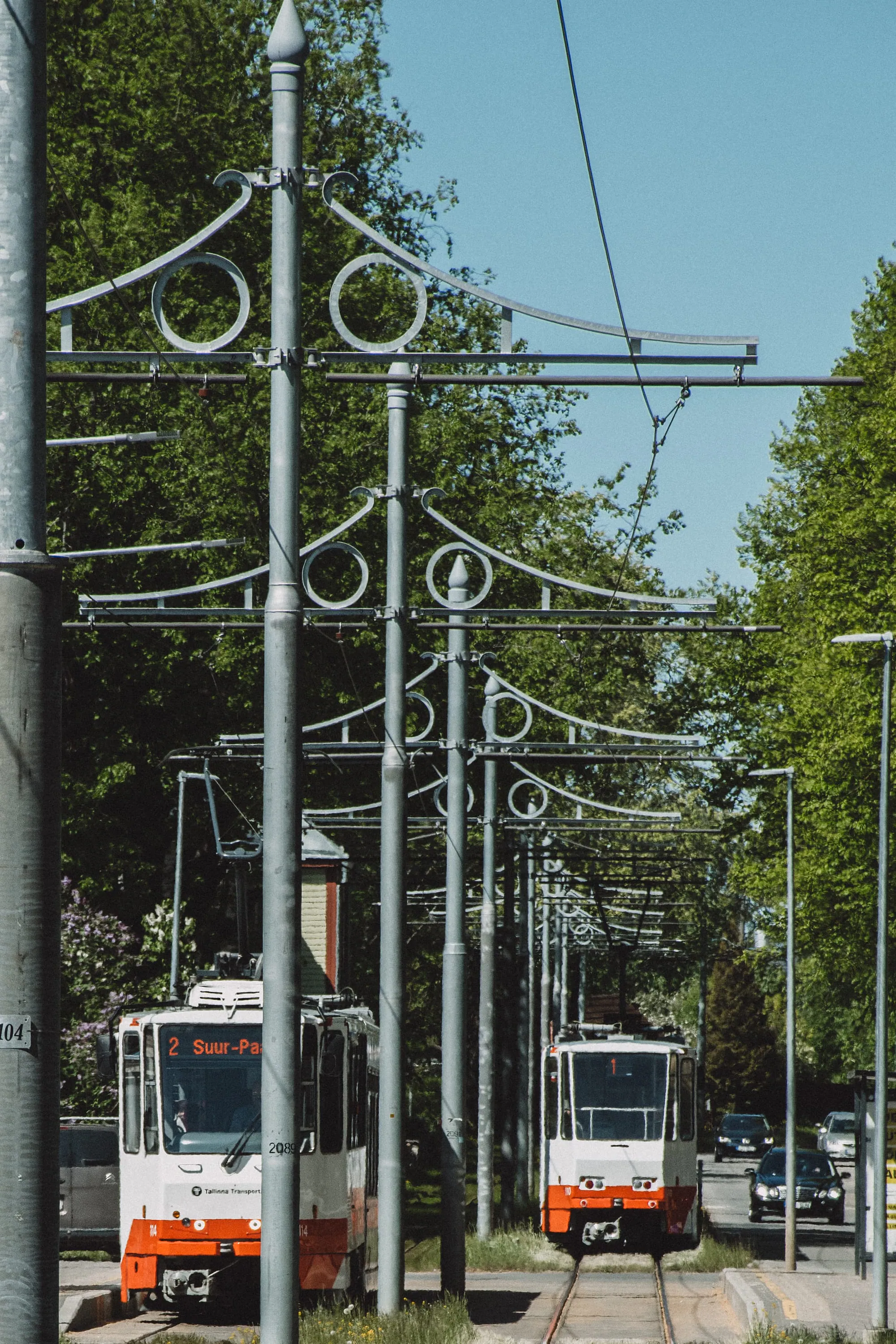
The tram wires made the first sound: a dry metallic hum above Kopli Street, followed by the flat clatter of wheels crossing a joint in the rails. It was late morning on 31 May 2020. Sunlight struck the overhead poles hard enough to bleach their edges, while warm asphalt and flowering lilac gave the street two incompatible smells at once. A tram appeared between the repeating loops of the old line furniture, orange-white against the green trees, and for a second the whole peninsula seemed to organise itself around that narrow pair of rails.
I returned on 6 June under a less obedient sky. Clouds moved quickly over factory roofs; bright façades fell into shade before I had finished framing them. That instability suited Kopli. Northern Tallinn is often introduced through its transformation, yet the photographs are more interesting when the old and new are allowed to occupy the same frame: a chimney between apartment blocks, weeds against brick, a polished courtyard facing a wall whose windows have been empty for years.
The tram line as a visual spine
Kopli works well as a photo walk because the tram keeps returning as a point of orientation. The line was not originally built for visitors. Tallinn’s official history of the district records that a tramway began operating here in 1912, connecting the Russian-Baltic Shipyard administration building with Sitsi hill. The industry came first; mobility followed the workforce.
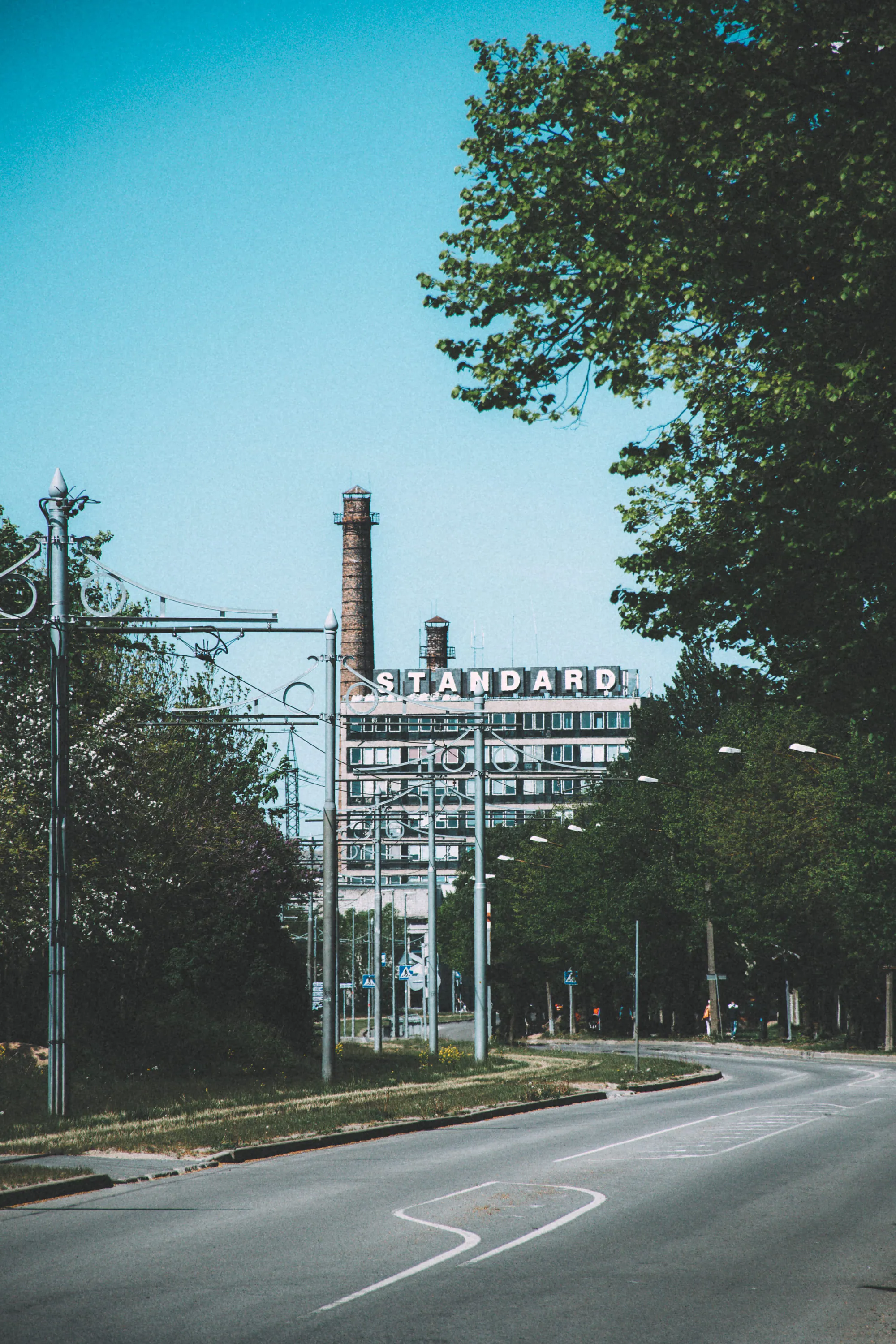
That origin is still legible. Look north along Kopli Street with a moderate telephoto and the rails, cables, lamp standards and façades compress into a dense piece of urban machinery. With the 18–140mm lens used for this series, the longer end removed empty foreground and stacked the tram against the factory skyline. A wider lens would explain the street more literally, but it would lose the sensation that every line is pulling toward the peninsula.
Before the factories: clay, pasture and trees
The industrial image is only one layer. Medieval records cited by the City of Tallinn mention a brickworks in Kopli in 1365 and livestock wardens in 1372. The district’s name belongs to that older landscape of enclosed grazing land: the Estonian word kopli refers to a paddock or pasture. Tallinn’s geology helps explain the brickmaking. Cambrian blue clay lies beneath the city’s coastal lowland, and the same material was used by brickworks on the peninsula.
Kopli rises only to about 15 metres above sea level. There is no limestone escarpment like the one on the western edge of the city, where my Astangu photo walk follows woodland beneath a much sharper geological boundary. Here the land feels horizontal. Chimneys, cranes and apartment towers become the artificial relief.
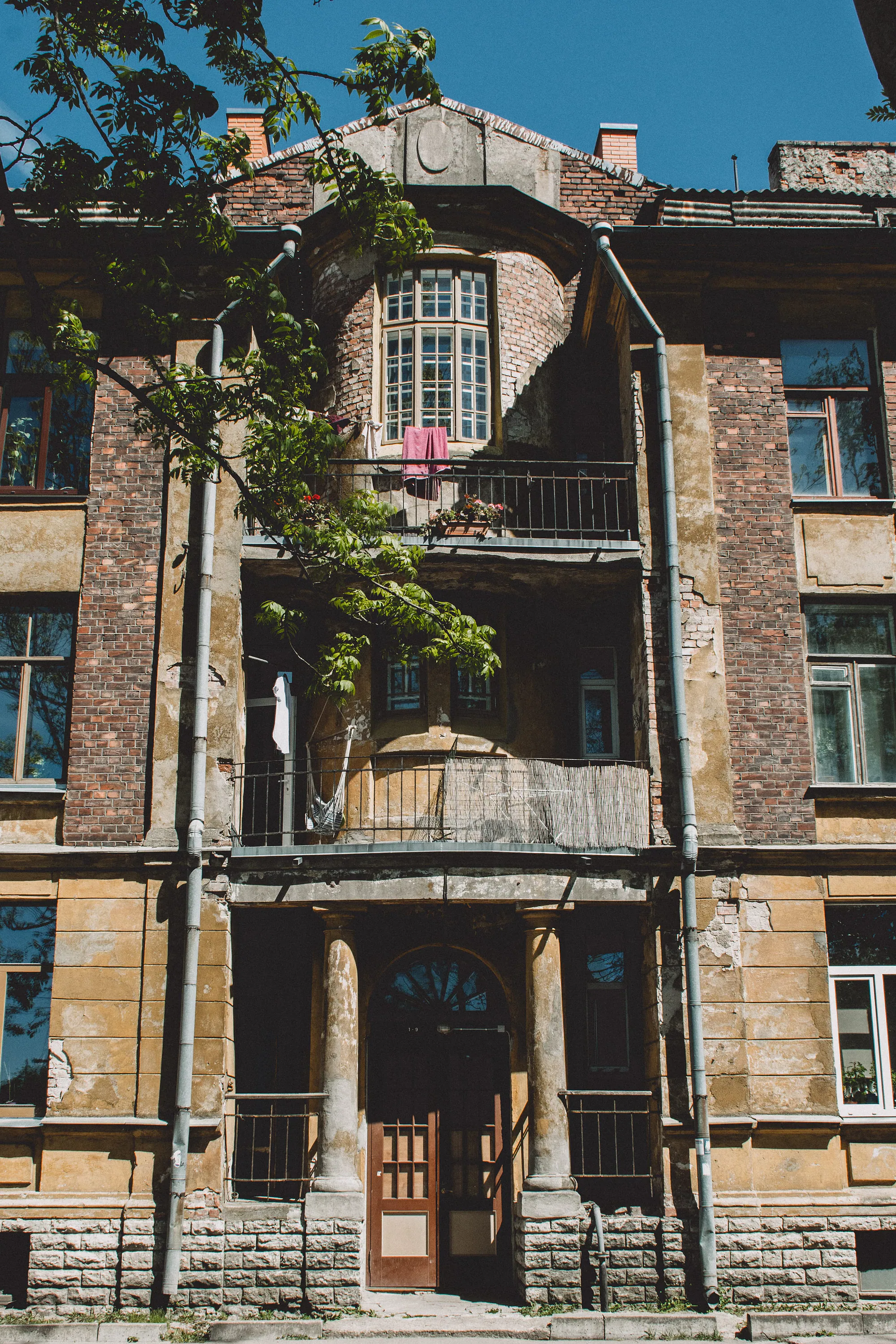
By the late nineteenth and early twentieth centuries, that low coastal ground had been remade by industry. The Baltic Cotton Mill and its workers’ settlement rose around Sitsi. Between 1912 and 1916 the Russian-Baltic and Bekker shipyards were built with extraordinary speed, together with housing for their workers and officials. According to the city’s district history, the Russian-Baltic Shipyard alone employed 7,500 people in 1916. Kopli was not a factory beside a neighbourhood. The factory produced the neighbourhood.
Reading walls instead of landmarks
The best subjects are not always the famous buildings. A grid of factory windows can carry more information than a postcard view: panes replaced at different dates, rust running from metal frames, pale bricks darkened beneath the sill. Photograph these surfaces straight on. Even a slight tilt makes the verticals quarrel, so step backward, keep the camera level and use the middle of the zoom rather than forcing the frame with an extreme wide angle.
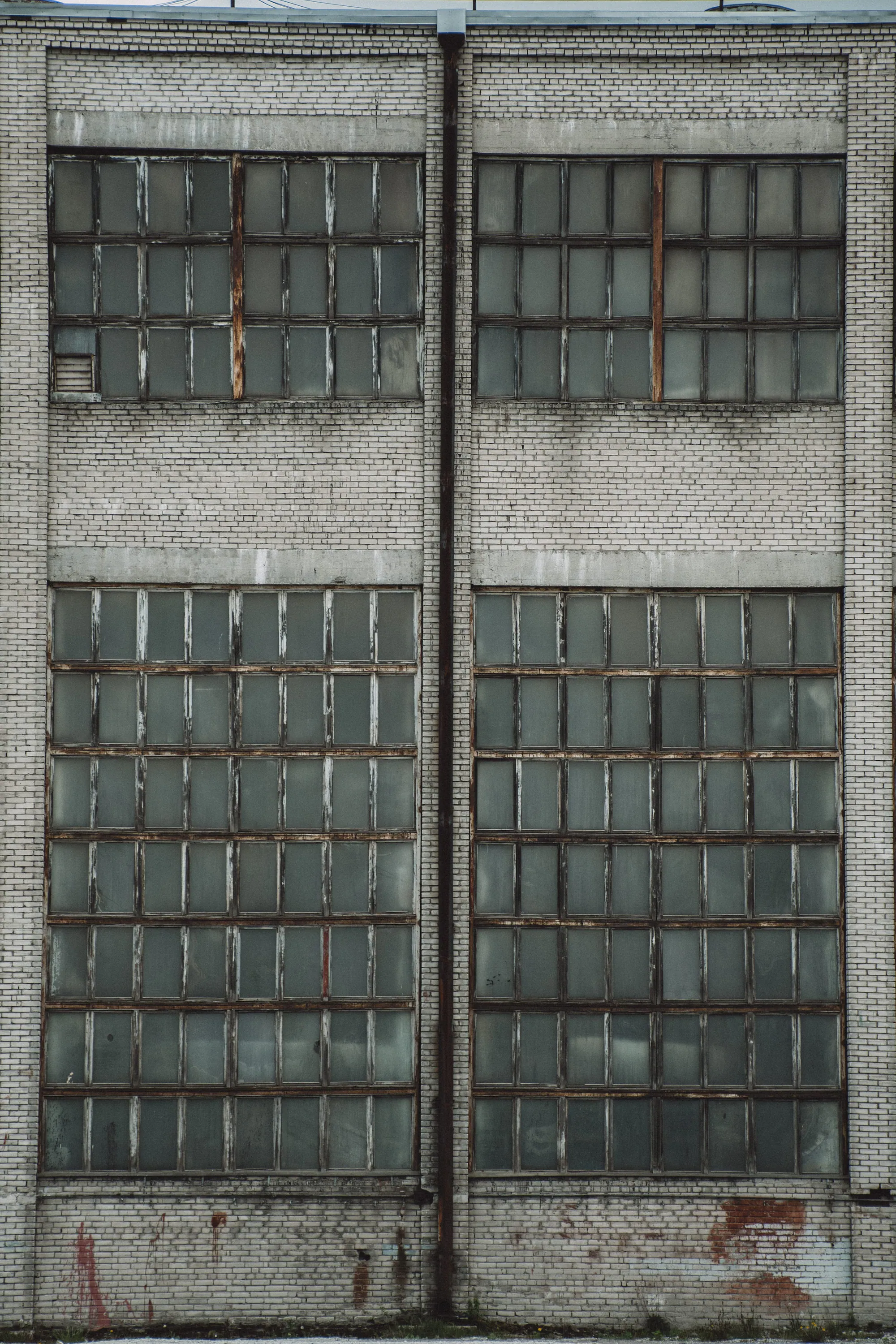
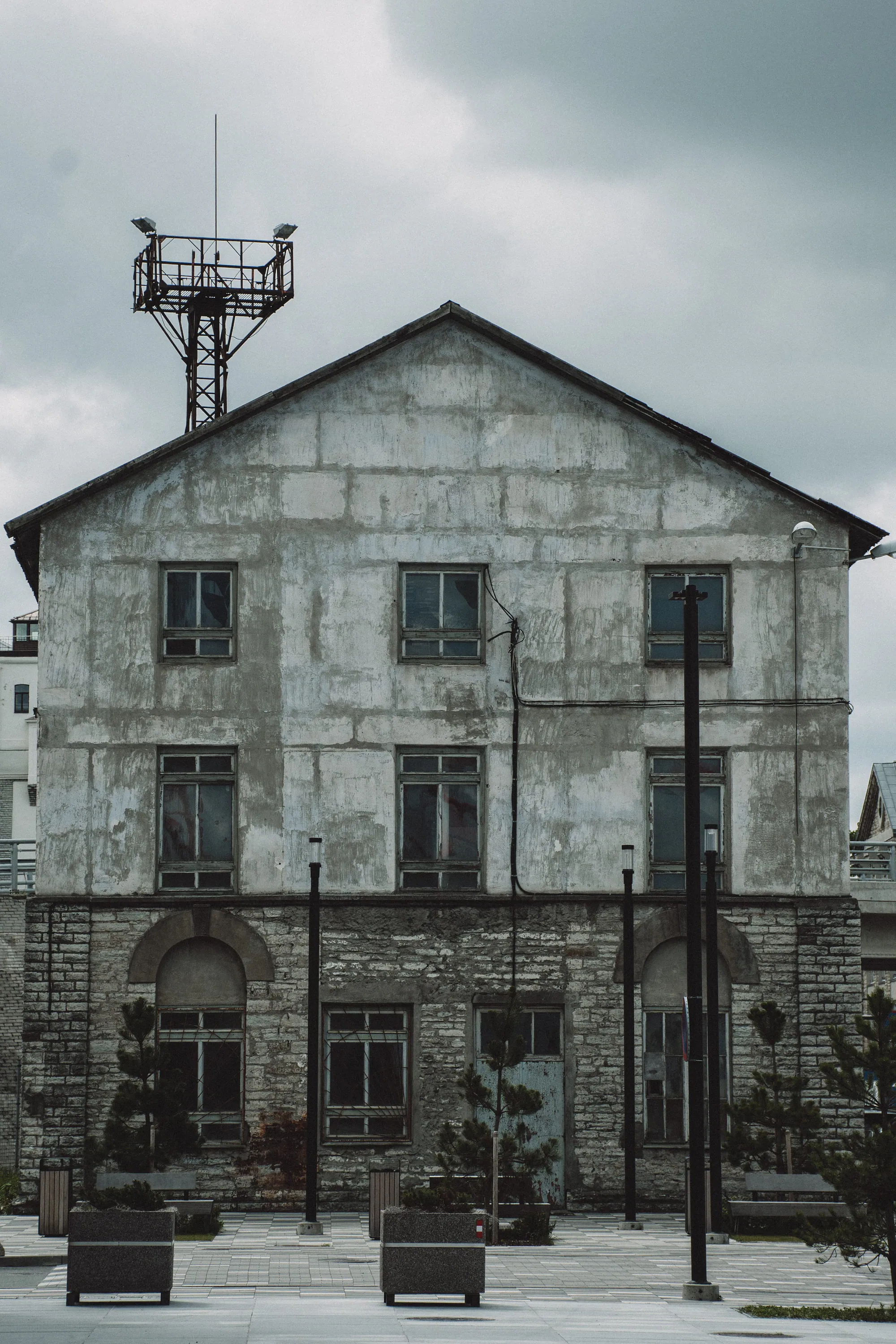
Cloud is particularly useful on the pale industrial façades. It keeps chalky render below clipping and lets the darker window openings retain detail. On the second walk I worked mostly at ISO 100, between roughly f/5.6 and f/10. The first, brighter outing had been left at ISO 500—more than the light required, but still clean enough on the Nikon D7500 and fast enough to catch trams without hesitation. The EXIF is a useful reminder: technically perfect settings matter less than being ready when several moving layers align.
A peninsula built around work
Industrial Kopli was planned as a system: workshops, transport, administrators’ houses, workers’ barracks and communal buildings. Its scale still shifts abruptly. A modest doorway may sit minutes from a façade designed to make a shipyard look permanent, which is why a normal-to-telephoto zoom suits the area better than one fixed viewpoint.
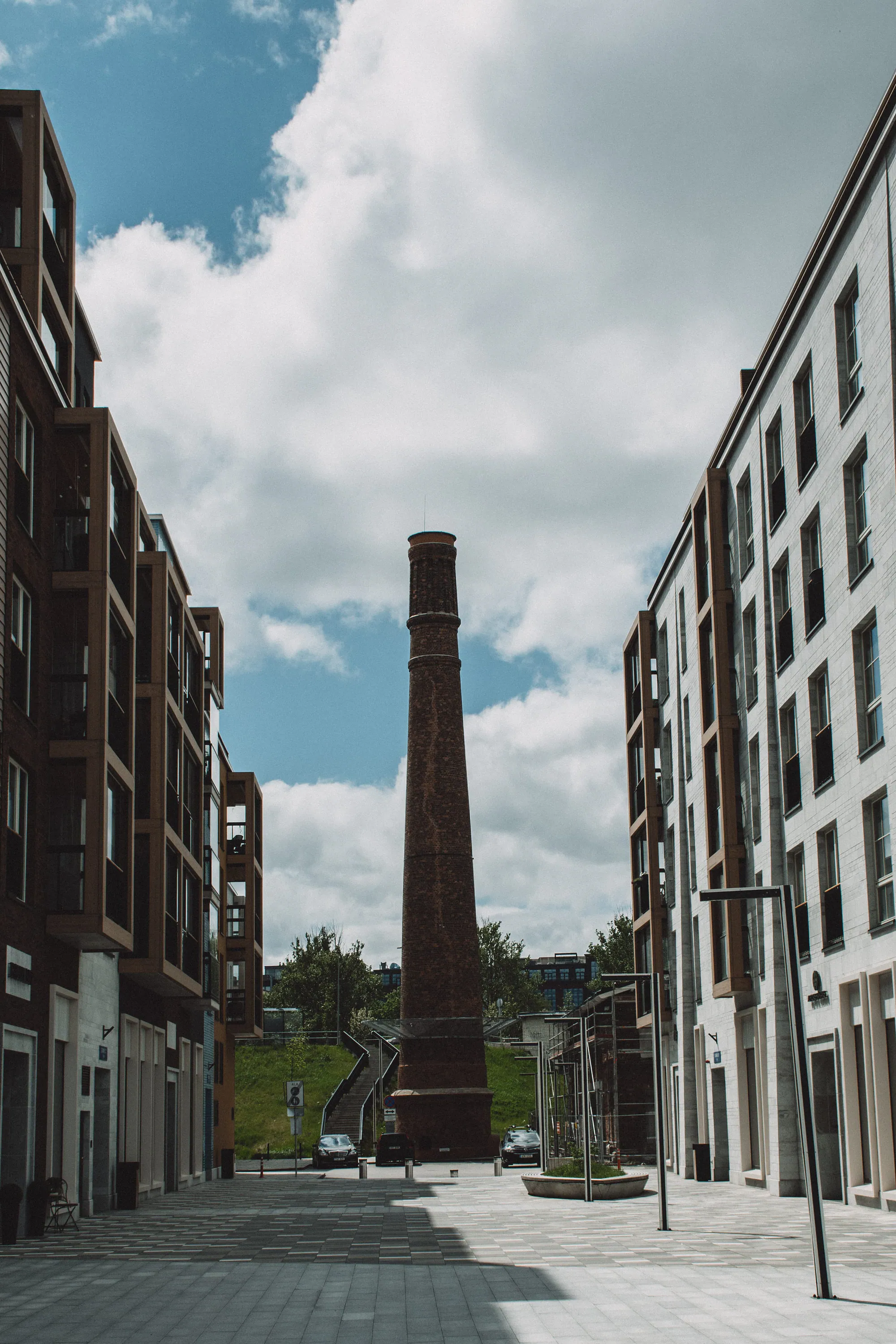
Change is not merely historical. In 2025 Tallinn advanced a detailed plan for nearly 13 hectares in the western Kopli Lines area, including the construction or renovation of 33 apartment buildings and a proposed public seaside promenade. That does not make every surviving wall a romantic ruin, nor every new building an intrusion. It does mean that photographs from 2020 have already become a dated record. The honest caption is sometimes simply the year.
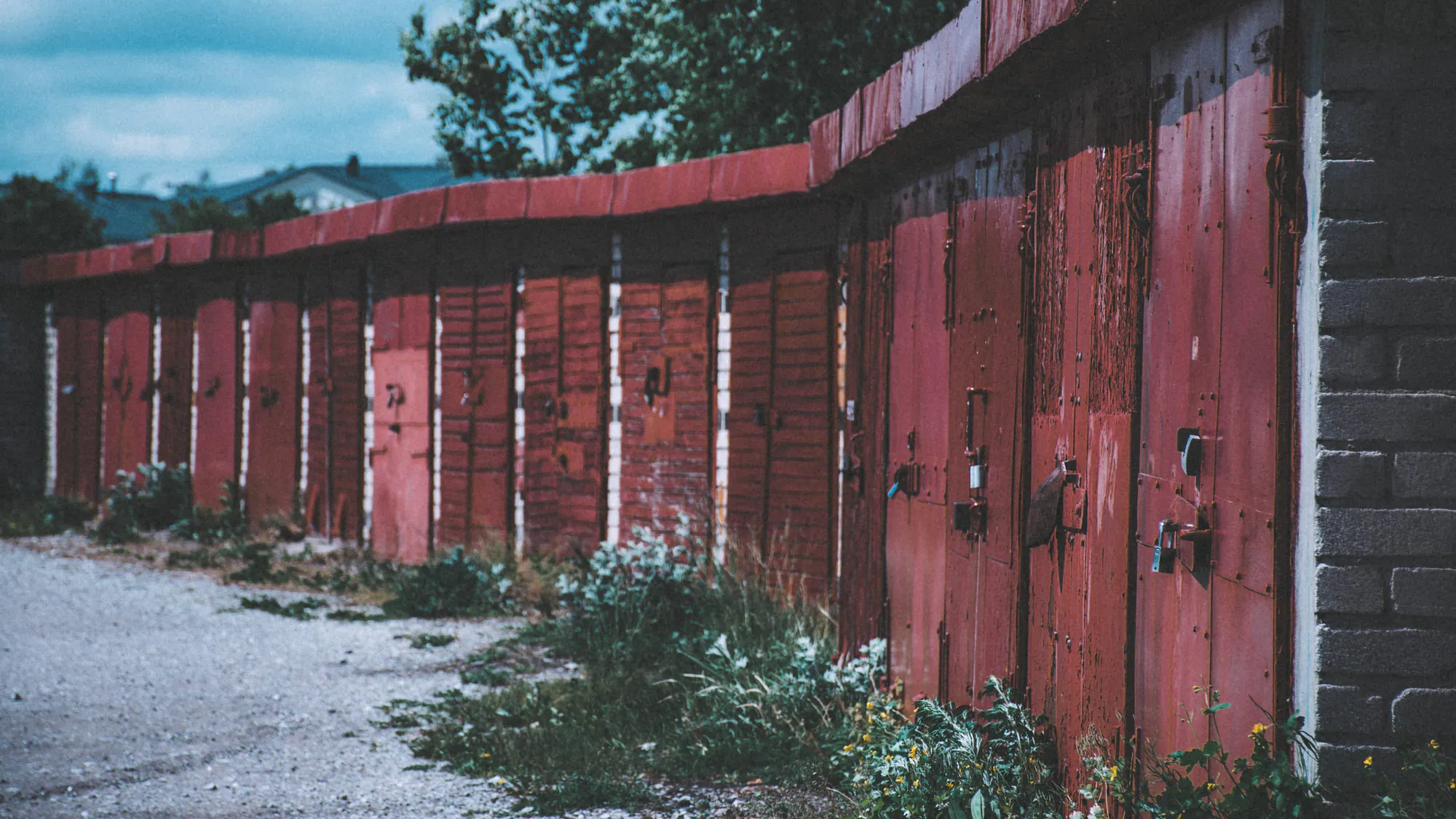
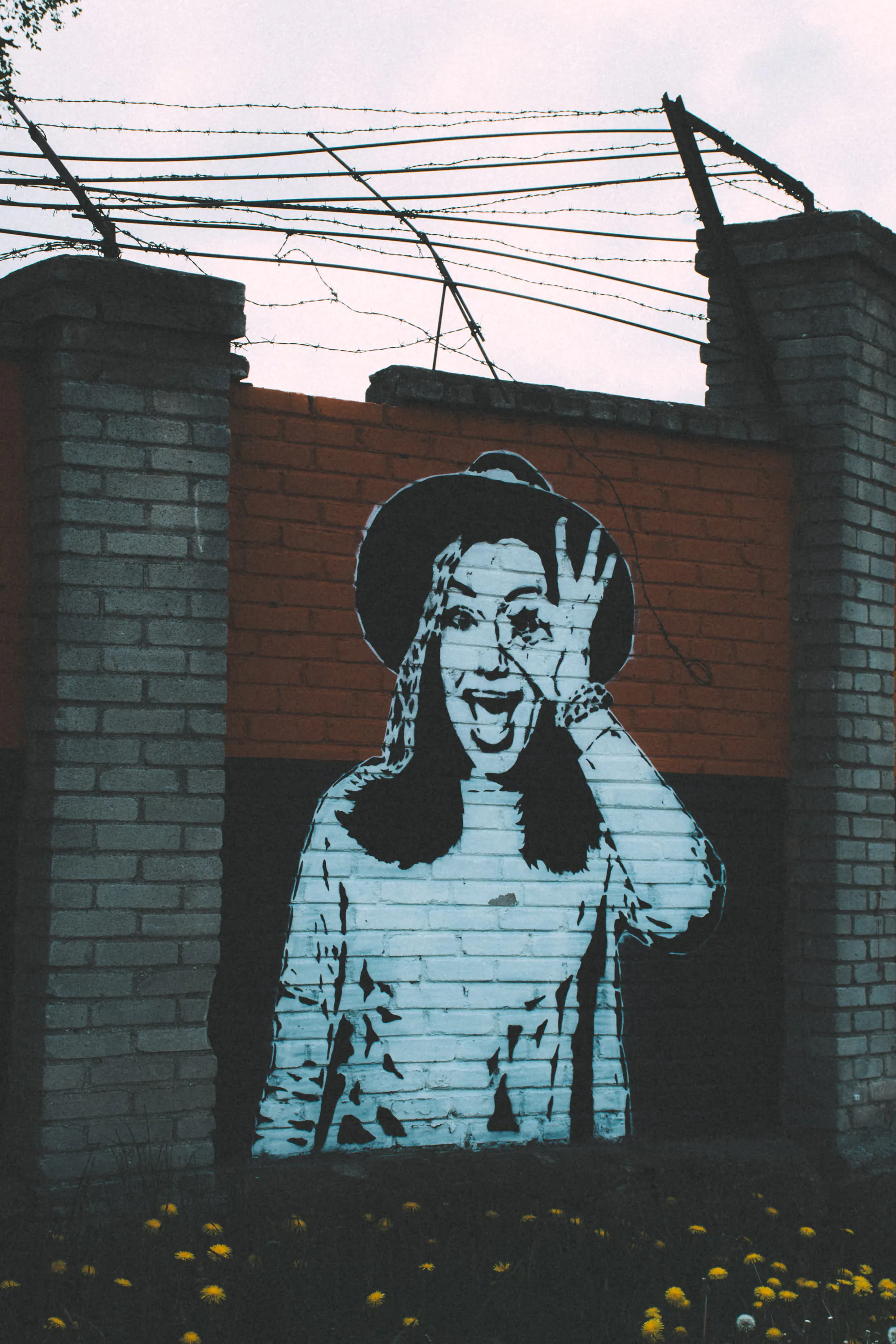
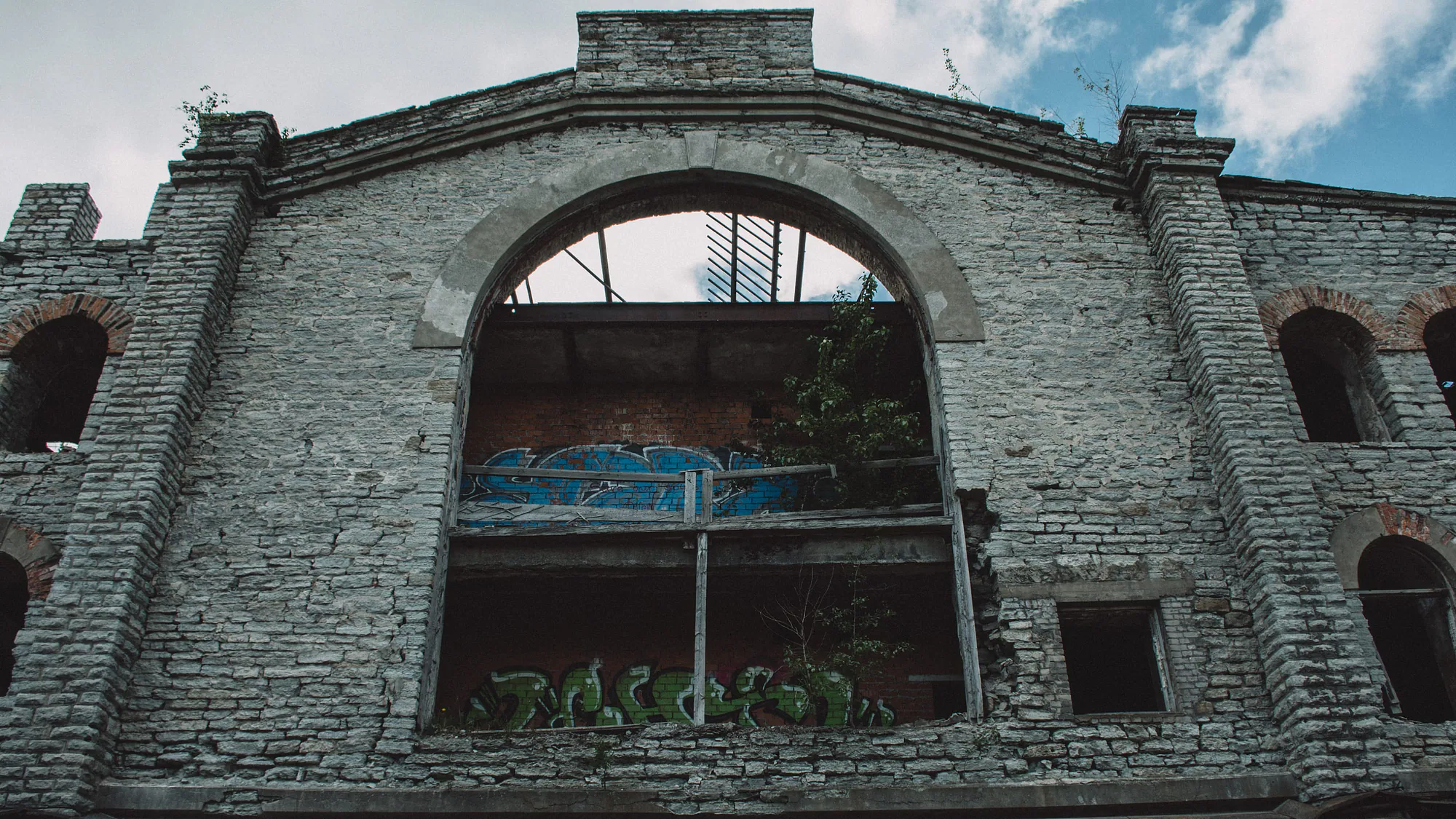
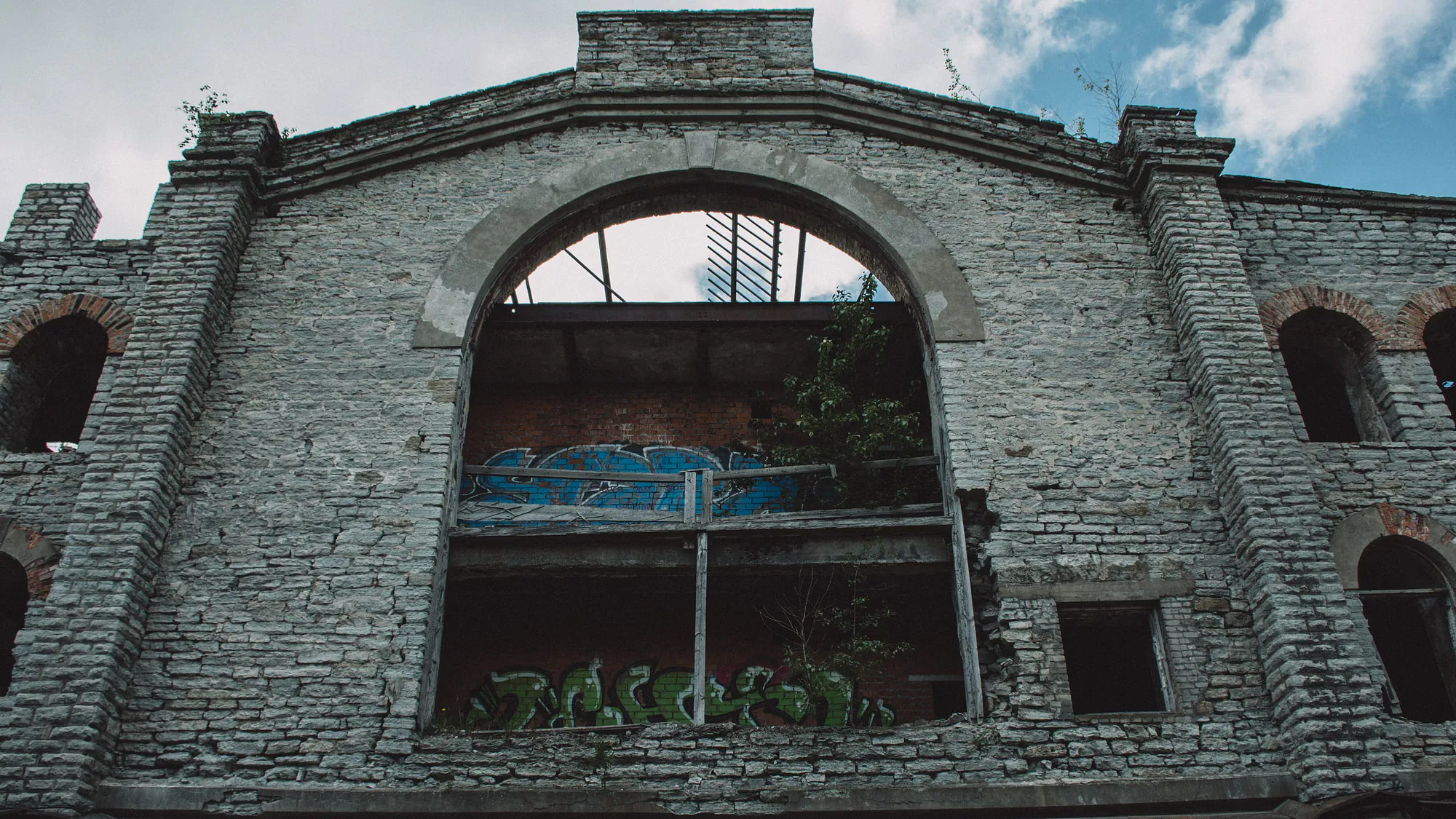
One wall stopped me longer than the grander structures. A painted face covered its eyes with both hands, but two fingers opened just enough to look back. Across the street, windows were missing from an arched factory shell. The pairing was almost too neat. I moved until the mural and the ruin became separate frames; together they explained the joke, apart they kept some tension.
Green evidence between brick and sea
Vegetation in Kopli is not decorative filler. Birch, willow, grasses and young pines occupy verges, courtyards and disturbed ground, softening boundaries that once looked absolute. These are resilient urban communities rather than untouched nature. Along the coast, wind and saline spray favour plants that can tolerate exposure; farther inland, sheltered plots grow dense quickly during Tallinn’s long June days.
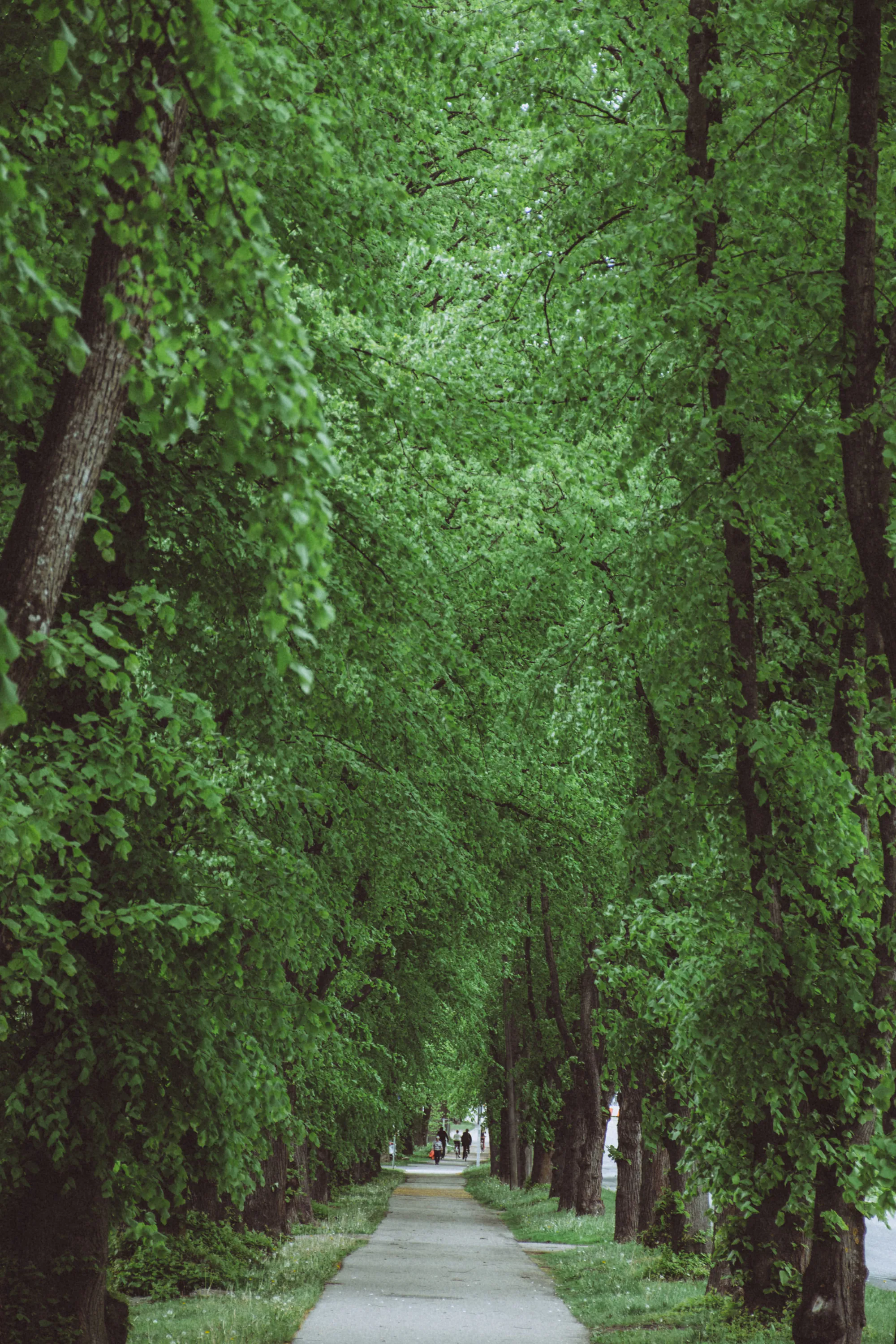
The most historically charged green space is Kopli Cemetery Park. The cemetery was established in 1774 for the congregations of St Olaf’s and St Nicholas’ churches, closed in 1950 and converted into a park in 1951. Tallinn’s environmental department notes that an oak roughly 350 years old survives there, older than the cemetery itself, along with unusual planted trees including white pine and Siberian stone pine. Photographing the park requires a different pace. It is a former burial ground, not merely a convenient patch of shade.
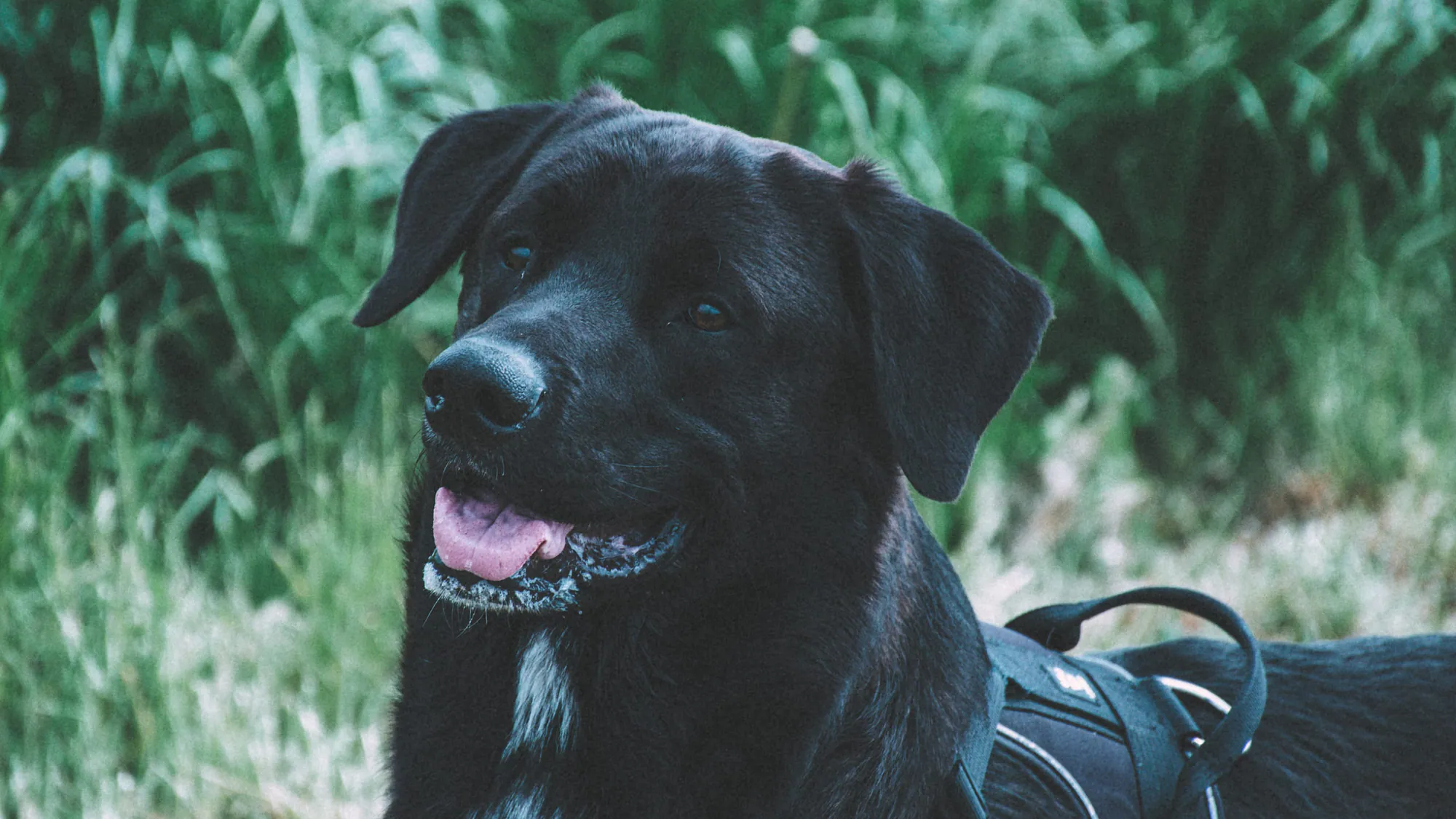
A black dog supplied the day’s least architectural photograph. It turned, looked directly into the lens and immediately resumed walking. That half-second matters in a series dominated by empty windows: suddenly the place looks inhabited rather than surveyed.
Photographing Kopli without flattening it
Bright summer light can make the district look harsher and simpler than it is. Protect highlights on pale render and clouds, then lift the shadow side of brick cautiously in post-production. A polariser helps with foliage and glass but can make a wide blue sky uneven.
Three focal-length habits worked repeatedly:
- 35–50mm equivalent for façades with enough surrounding context to show the street.
- 70–140mm for compressing trams, poles, chimneys and the distant Tallinn skyline.
- Close focus at the long end for pine flowers, peeling paint and plants colonising masonry.
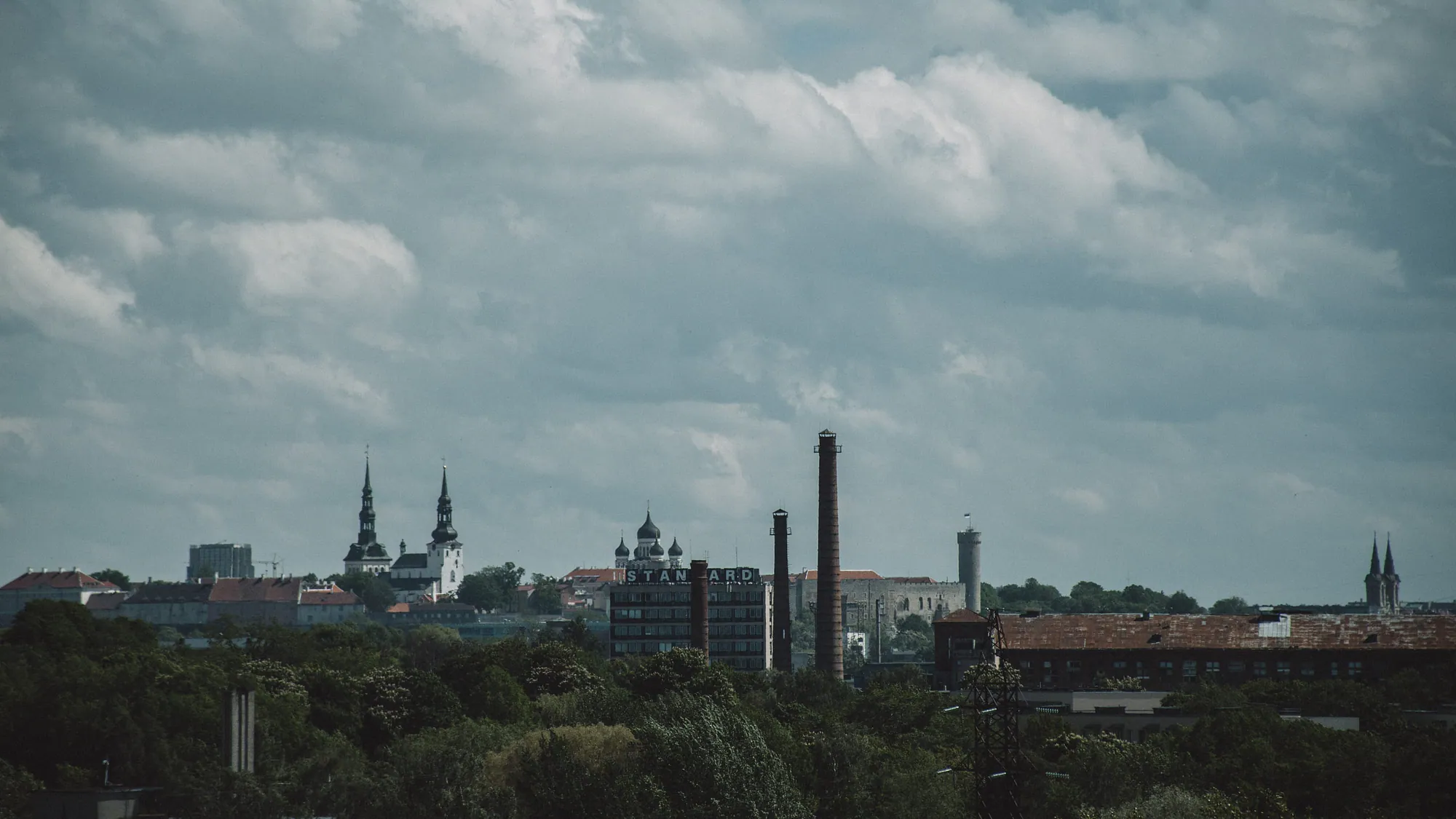
Keep people small unless they have clearly agreed to a portrait. Many homes open directly onto the streets that make the best compositions, and a long lens can become intrusive quickly. Active ports, construction sites and abandoned buildings also have real boundaries. Every photograph in this story can be made from a public street, path or park. A broken window is not an invitation.
A practical Kopli photo route
Begin at Sitsi tram stop and follow Kopli Street north. The first section provides tram geometry, the surviving industrial fabric around Sitsi and long views toward chimneys. Continue on public streets toward the Kopli Lines area, using side streets only where pedestrian access is clearly open. From there, include Kopli Cemetery Park and finish at the Kopli tram terminus. Depending on detours, the walk is roughly four kilometres; allow three hours if you stop for façades and wait for trams.
Use Tallinn’s official journey planner on the day of travel because tram assignments and construction diversions change. Tram line 2 has linked Kopli with the Old City Harbour and Suur-Paala since December 2024, but the live timetable is the authority. Early weekend mornings reduce parked-car clutter; a bright overcast afternoon is better for wall detail. After rain, the old brick deepens in colour and tram rails become strong highlights, though smooth paving and rails can be slippery.
Pack one camera body, a normal-to-short-telephoto zoom, a spare battery, lens cloth and a light rain cover. Leave the tripod unless blue hour is the purpose: pavements are narrow in places, and handheld work responds better to trams, dogs and sudden gaps in traffic. Wear ordinary walking shoes rather than hiking boots. Carry water, but keep the bag small enough to remain comfortable on public transport.
If the industrial edge gives way to a stronger interest in reeds, birds and open water, continue the story with my Paljassaare field note. Kopli asks for a different kind of attention. Its history is not hidden; it is distributed across rail, brick, trees and the unequal ages of neighbouring walls. Walk slowly enough and the peninsula begins to read like an archive left outdoors.

Sources and further reading
- City of Tallinn: history of Kopli
- City of Tallinn: Kopli Cemetery Park
- Estonian Encyclopaedia: Tallinn’s landscape and geology
- City of Tallinn: western Kopli Lines planning proposal
- City of Tallinn: Old City Harbour tramway
Curated Gallery
Explore urban and industrial photography from this series: Kopli Architecture & Coastal Gallery →
Discussion
Thoughts on this story?
A quiet place for questions, experience and considered discussion.
Discussion guidelines
Stay relevant and constructive. No spam or harassment; links may be moderated.
Opening the discussion…